The 10 best sales engagement platforms in 2026
The 10 best sales engagement platforms in 2026, compared on AI execution vs. human orchestration, pricing, and what changed in the category.
Artisan is the best sales engagement platform for most B2B teams in 2026 because it is the first where the AI executes the cadence itself, writing, sending, replying, and booking, rather than orchestrating humans through task queues. Outreach and Salesloft remain the enterprise governance standards, and Apollo is the value all-in-one, if a rep-driven model fits you better.
Comparison table
Platform | Best for | Standout capability | Public pricing |
|---|---|---|---|
Artisan | Teams that want the cadence executed, not just organized | Ava writes, sends, replies, and books, with autonomy you dial | Usage-based, free trial |
Outreach | Enterprise governance and forecasting | Omni conversational agent on a mature workflow platform | Not public; Vendr median $45,600/yr |
Salesloft | Enterprise revenue orchestration after the Clari merger | Engagement plus Clari forecasting from one vendor | Not public; Vendr average $30,720/yr |
Apollo | Value all-in-one: data plus engagement | Large contact database under the sequencer | Free to $119/user/mo |
HubSpot Sales Hub | Teams standardized on HubSpot CRM | Breeze agents priced on outcomes | Seats free to $150/mo, plus credits |
Reply.io | Multichannel sequencing at SMB prices | Jason AI layered on a mature sequencer | From $59/mo; $99/user/mo multichannel |
Klenty | Budget teams wanting calling built in | Cold calling and AI call coaching at SMB prices | $50 to $99/user/mo |
Amplemarket | Mid-market data plus engagement plus AI | Duo AI agent across the full workflow | From about $600/mo |
Instantly | High-volume cold email specialists | Unlimited sending accounts with warmup | $47 to $358/mo |
Groove (Clari) | Existing Salesforce-native Groove customers | Deep native Salesforce architecture | Quote-based |
Pricing is point-in-time and attributed to vendor pricing pages, or to buyer-reported figures where noted. Gated vendors, meaning Outreach, Salesloft, and Groove, publish nothing, so any figure for them is a third-party estimate.
How we chose these platforms
Five criteria, weighted for what 2026 buyers actually face: execution model, meaning does the platform do the work or assign it; multichannel depth across email, phone, and social in one cadence; AI substance versus AI branding; total cost including the data and deliverability tools you must bolt on; and vendor stability, which mattered this cycle given a merger, a breach-driven product retirement, and two acquisitions among the incumbents. Every entry names who should pick something else.
What are the best sales engagement platforms in 2026?
The best sales engagement platforms in 2026 are Artisan (AI-executed cadences), Outreach and Salesloft (enterprise orchestration), Apollo (value all-in-one), HubSpot Sales Hub (CRM-native), Reply.io and Klenty (SMB multichannel), Amplemarket (mid-market AI), Instantly (volume email), and Groove (Salesforce-native, in transition). Ranked below.
1. Artisan: Best for teams that want the cadence executed, not orchestrated
Every other platform on this list was built to organize human effort. Build a sequence, load prospects, generate tasks for reps to complete. Artisan was built the other way around. Ava, its AI business development representative (BDR), executes the cadence herself. She finds leads across a database of over 250 million B2B professionals in over 200 countries, plus Artisan Local Data with over 250 million local businesses, enriches them with waterfall email and phone enrichment, writes individual messages, sends across email and social media, handles replies and objections from a knowledge base, and books meetings on reps' calendars. Call steps queue into the built-in dialer with AI talking points generated for each lead.
Two people in the same campaign receive two different emails, not the same template with a swapped first name. That is the part worth testing in a trial.
The autonomy is a dial rather than a switch. Ava can draft every message and wait for your approval, or write, schedule, and send on her own, with autonomous replies governed by escalation rules you write in plain English that say when a conversation goes to a person. The sequencing engine also runs dozens of message variations at once and shifts volume toward whatever converts, which legacy A/B testing does not do. Deliverability is handled through separate secondary sending domains, pre-send checks that catch addresses likely to bounce or draw spam complaints, per-mailbox daily send limits, and sending windows by timezone.
Artisan's honest limit: there is no AI voice on calls. Ava prepares and queues the call and writes the follow-up afterwards, and a human rep has the conversation. If you want an AI that talks to prospects on the phone, this is not that product.
SaaStr sent 6,892 emails through Ava in about six weeks, 3,574 of them to net-new leads, at a 3.6% positive response rate and 49.4% acceptance on social media connection requests. Amelia Lerutte, SaaStr's Chief AI Officer: "Email has always been our number one driver. Artisan is now neck-and-neck in both output and closed-won revenue."
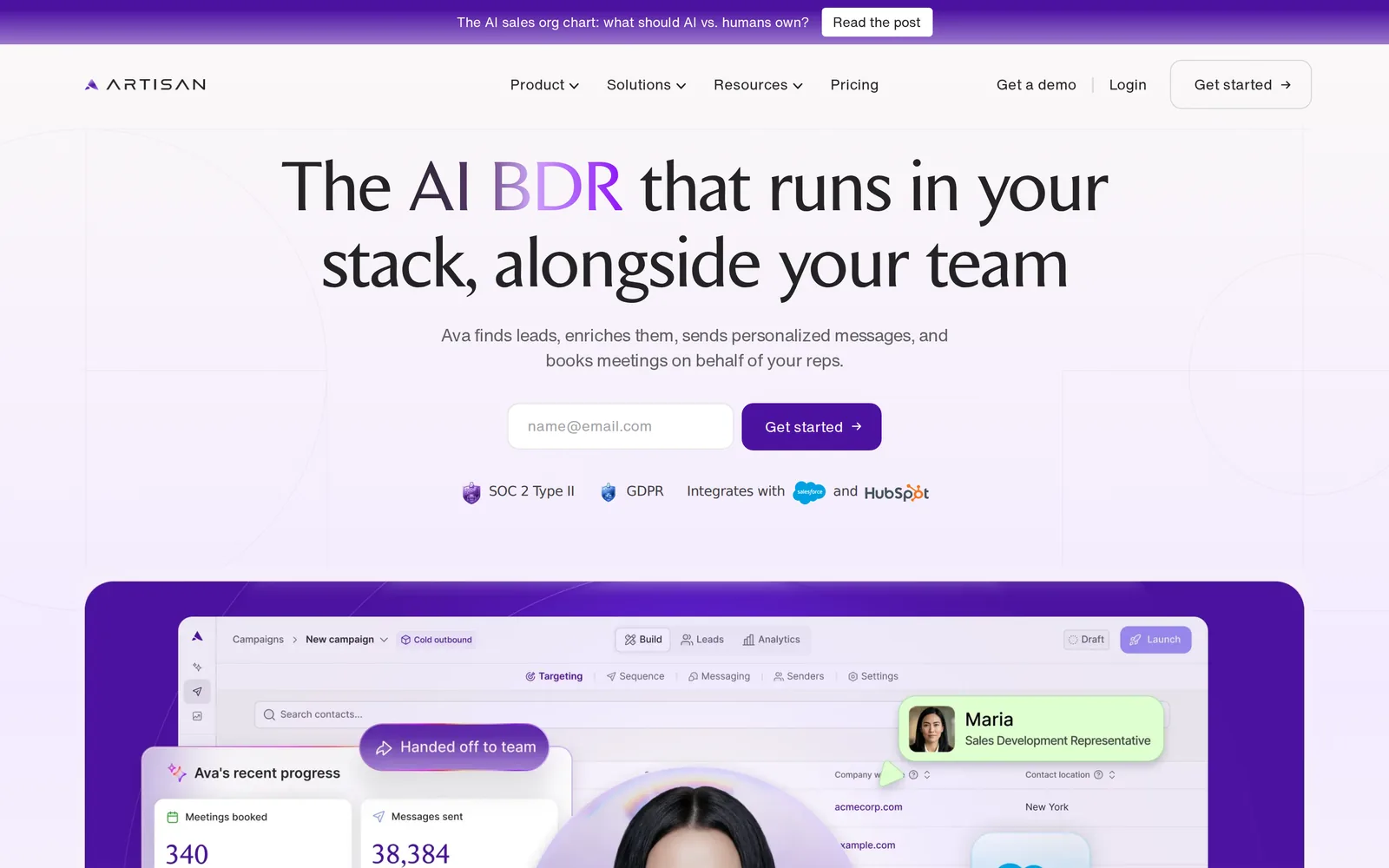
Best for: teams from founder-led self-serve up to enterprises running Ava centrally from sales ops, that want pipeline output from their engagement platform rather than a better-organized task queue, and teams consolidating data, sequencer, dialer, and deliverability spend into one system. Who should pick something else: teams whose core need is governance, forecasting, and coaching analytics across a human-rep motion, since Outreach and Salesloft are built for exactly that, and teams that want a pure manual sequencer with no AI in the loop. Pricing: usage-based, so you pay for work performed rather than seats, with a free trial. Details at artisan.co/pricing.
2. Outreach: Best for enterprise governance and forecasting
Outreach remains the enterprise reference: mature sequencing, conversation intelligence, forecasting, and the governance layer big revenue orgs require. On April 27, 2026 it shipped Omni, which it calls a universal conversational agent for the whole revenue org, reachable through Slack and a mobile app. It is a real step, and still an assistant inside a rep-driven system. Pricing is not public. Outreach has repackaged into four quote-based Amplify tiers, and Vendr's buyer data puts the median annual contract at $45,600 across 914 purchases. The smallest was $8,560 and the largest $213,832, so the median tells you very little about your own quote.
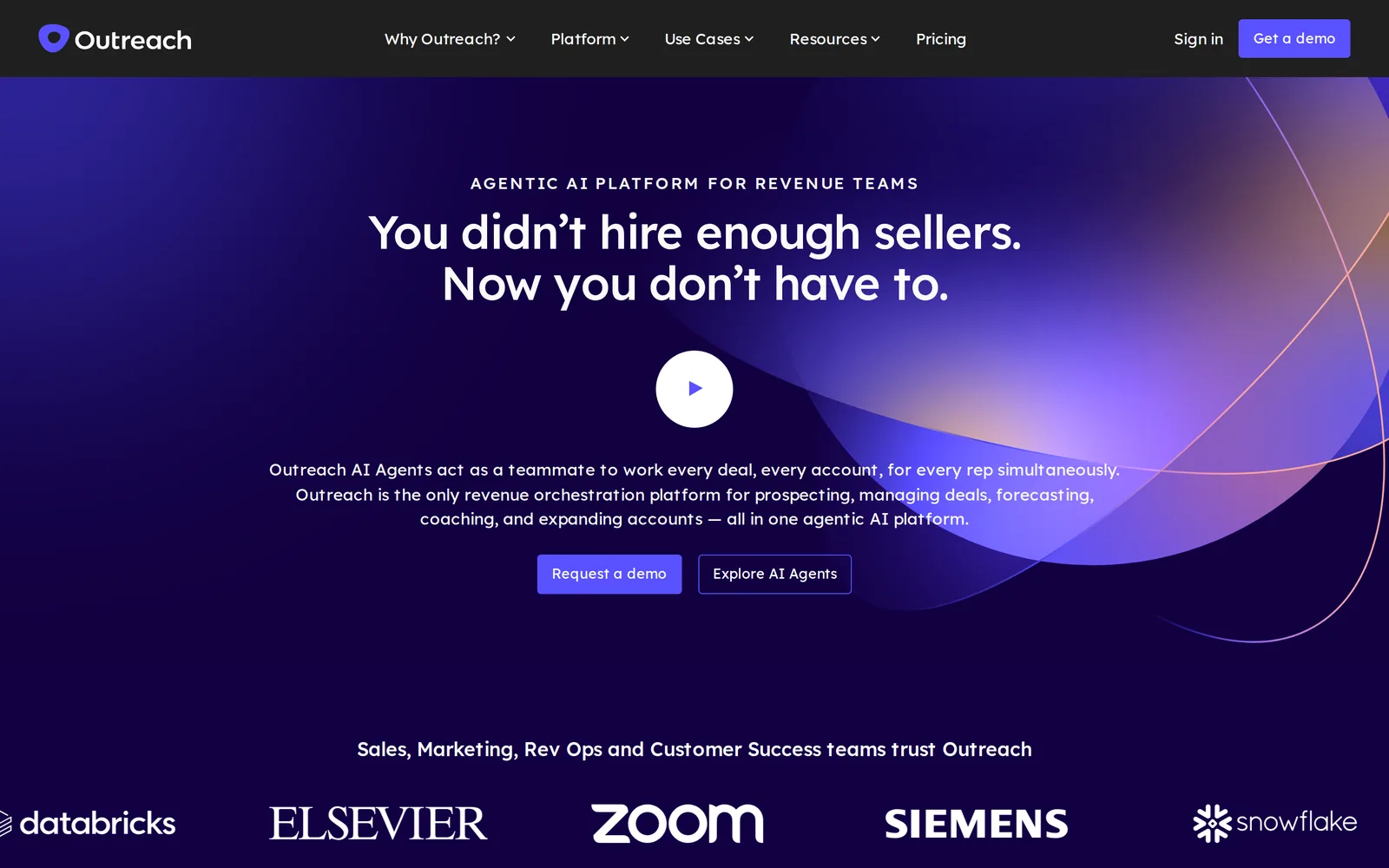
Best for: enterprises orchestrating large AE and SDR teams that need admin controls, forecasting, and compliance. Who should pick something else: lean teams without ops support, and anyone whose actual problem is that reps do not have time to work the cadences. Omni assists. It does not absorb the job. Pricing: not public; Vendr reports a $45,600 median annual contract.
3. Salesloft: Best for revenue orchestration after the Clari merger
Salesloft merged with Clari in a Vista-led combination that closed December 3, 2025, under CEO Steve Cox, and the combined company now brands itself Clari + Salesloft, with Salesloft covering top of funnel and Clari covering conversion and close. For a revenue leader who wants engagement and forecasting from one vendor, the logic is sound.
The caution flags are recent history. Drift, long part of the Salesloft family, was breached in August 2025 when attackers used stolen OAuth tokens from the Salesloft Drift app to pull data out of corporate Salesforce instances. Google's Threat Intelligence Group attributed the campaign to a group it tracks as UNC6395 and described the impact as widespread without giving a number; secondary reporting has put it above 700 organizations. Drift's retirement was announced in March 2026, with clients referred to 1mind. Post-merger product rationalization, including the overlap with Groove below, is still playing out.
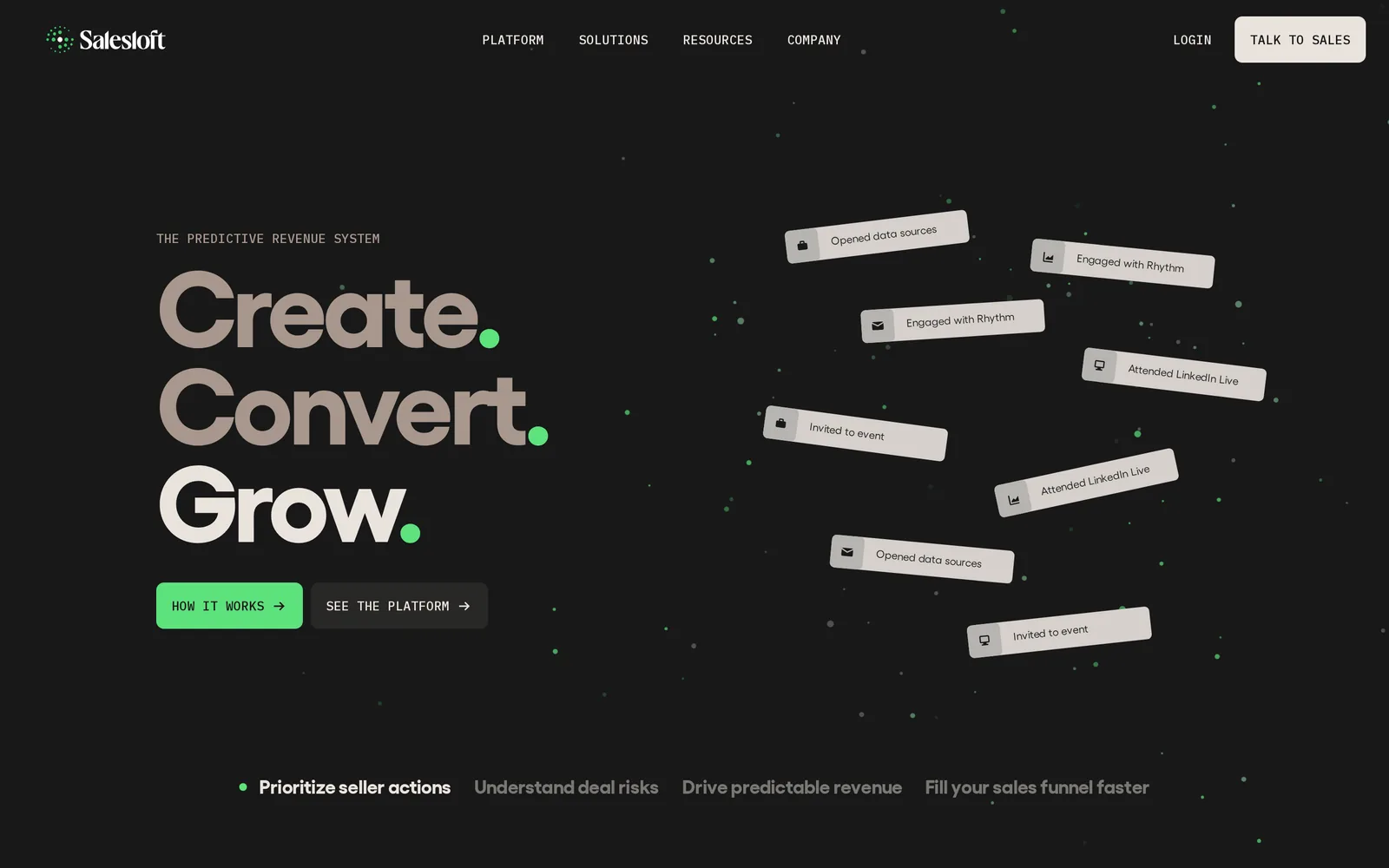
Best for: enterprises that want engagement and forecasting unified, and existing Clari customers. Who should pick something else: buyers who want a settled roadmap before committing, and small teams priced out of enterprise contracts. Pricing: not public; Vendr reports tier estimates of roughly $75 to $200/user/month and an average contract of $30,720 a year.
4. Apollo: Best value all-in-one
Apollo bundles a large B2B contact database, a sequencer, a dialer, and Pocus-derived intent after acquiring Pocus in March 2026, at prices no legacy SEP touches. Tiers run free, Basic $49, Professional $79, and Organization $119 per user per month on annual billing, with a three-seat minimum on Organization. Credits are a shared pool, and a phone reveal costs eight credits against one for an email, which is the number that actually shapes your bill.
Worth knowing before you buy: Apollo's AI is assistive, so humans still run the motion, and its deliverability tooling is thinner than a dedicated sender's.
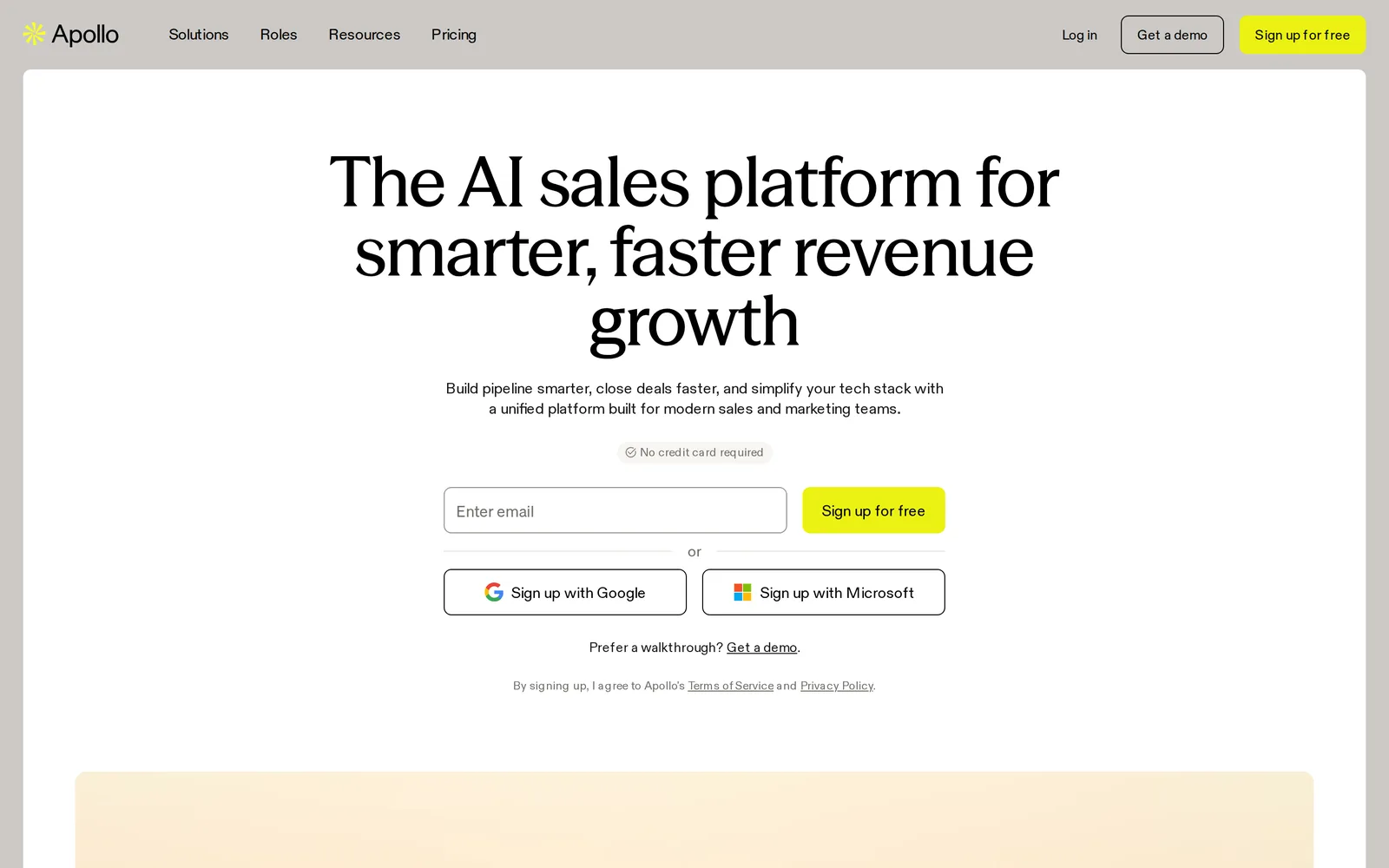
Best for: SMB and mid-market teams that want data and engagement in one affordable, self-serve tool. Who should pick something else: enterprises needing deep governance, and teams that want the platform to execute rather than assist. Pricing: free to $119/user/month.
5. HubSpot Sales Hub: Best for HubSpot-standardized teams
Sales Hub earns its slot on two counts: native CRM gravity and pricing innovation. On April 14, 2026, HubSpot moved two Breeze agents to outcome-based pricing, charging $0.50 per resolved conversation for the Customer Agent and $1.00 per qualified lead handed to sales for the Prospecting Agent, billed through HubSpot Credits at a cent each. Paying for results rather than seats is where the category's economics are heading, though HubSpot joined that shift rather than starting it.
Seat pricing runs free to $150 per seat per month (Starter $9, Professional $90, Enterprise $150 on annual billing), and the onboarding fees on Professional and Enterprise are real money on top. The sequencer itself is solid rather than category-leading, and the value case weakens sharply off-CRM.
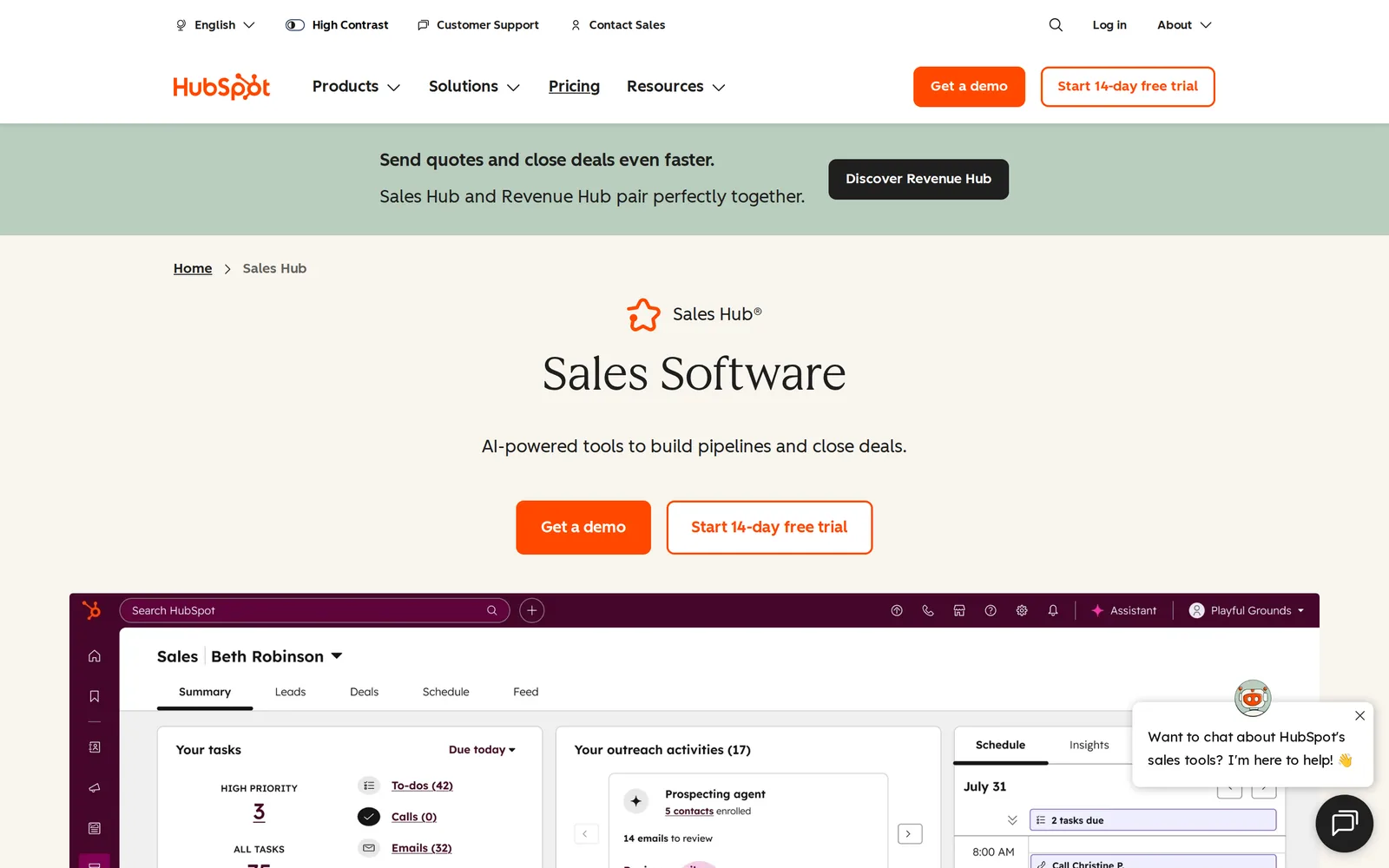
Best for: teams already running HubSpot CRM that want engagement plus outcome-priced AI agents. Who should pick something else: non-HubSpot shops, and outbound specialists who need deeper cadence and deliverability control. Pricing: seats free to $150/month, plus credit-based outcome pricing at about a cent per credit.
6. Reply.io: Best multichannel sequencing at SMB prices
Reply.io is the most complete budget multichannel platform: email, calls, and social steps from $59/month for sequences and from $99/user/month for multichannel, with Jason AI, its AI SDR layer, sold on top. It straddles the rep-driven and AI-executed worlds. Jason handles outreach and responses with less end-to-end workflow ownership than a dedicated AI BDR.
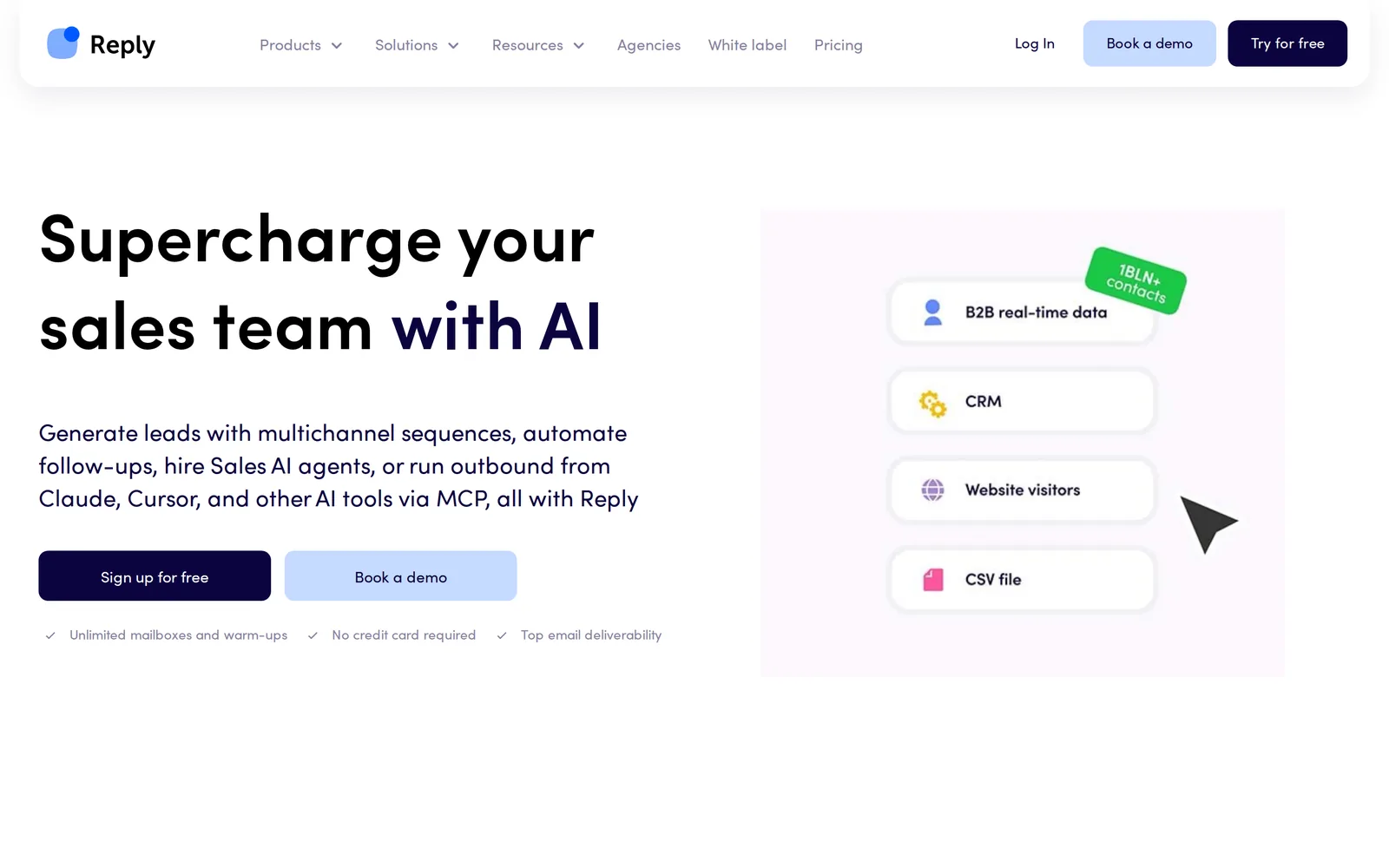
Best for: SMBs that want real multichannel cadences at transparent prices, with optional AI. Who should pick something else: enterprises needing governance, and teams wanting one system rather than a per-seat platform plus an AI add-on. Pricing: email from $59/month, multichannel from $99/user/month.
7. Klenty: Best budget platform with calling built in
Klenty publishes clean pricing and packs in more than the price suggests. Starter is $50/month for email only, Growth $70/user/month adds cold calling with 200 minutes and a one-click dialer, and Plus $99/user/month brings 1,000 minutes, account-based selling, and AI call coaching with live transcription and objection detection. A parallel dialer is a $45/user/month add-on. It remains a rep-driven system at heart, and its data layer is thin, so you bring your own lists.
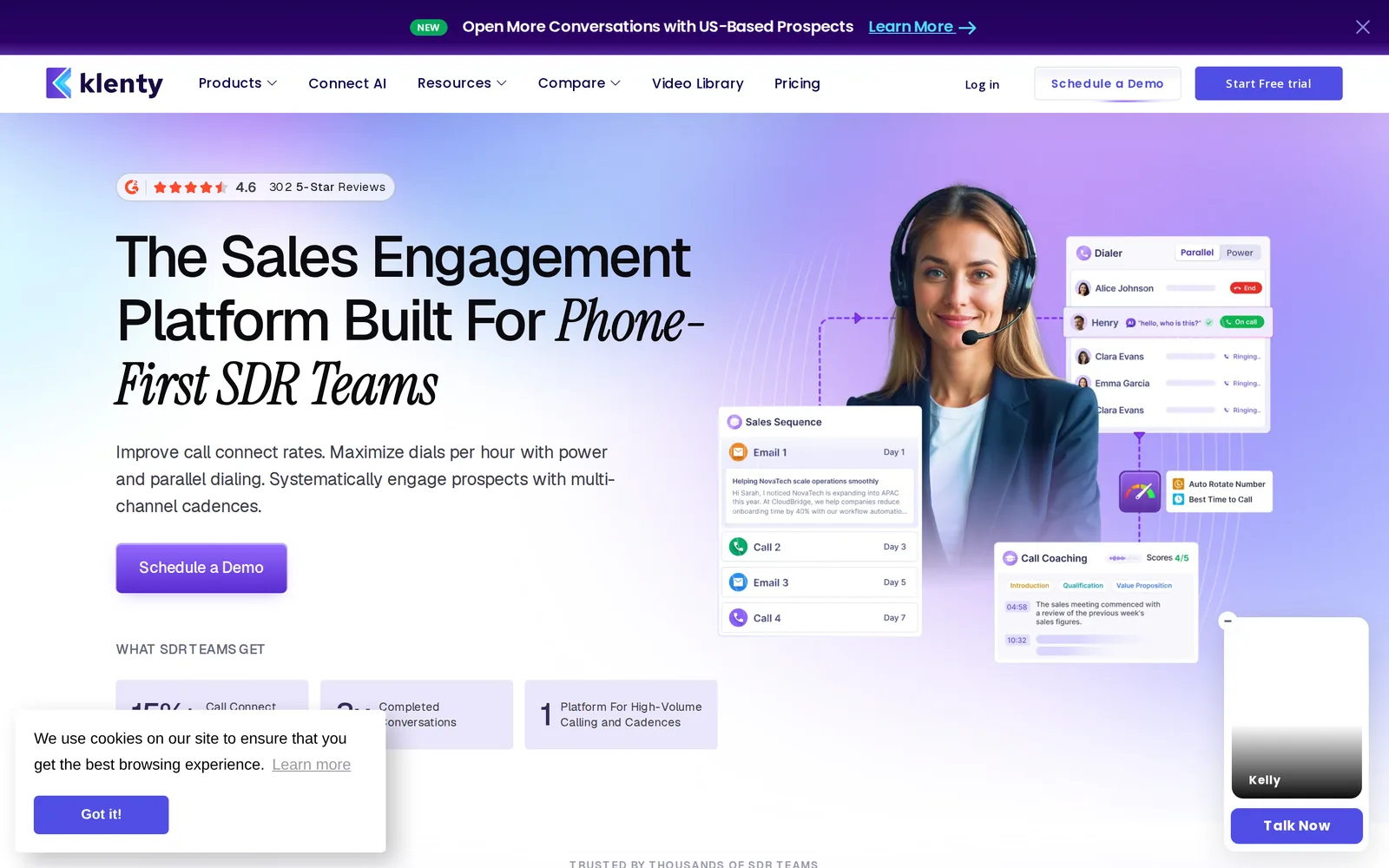
Best for: budget-conscious SDR teams that live on the phone. Who should pick something else: teams that need a native database or autonomous execution. Pricing: $50 to $99/user/month, plus $45/user/month for the parallel dialer.
8. Amplemarket: Best mid-market data-plus-engagement combo
Amplemarket bundles B2B data, multichannel engagement, and Duo, its AI agent, into one mid-market platform. The consolidation thesis is similar to Artisan's, executed with a more rep-assistive AI. Entry pricing is published from around $600/month on the Startup tier, and Growth and Elite are quote-based.
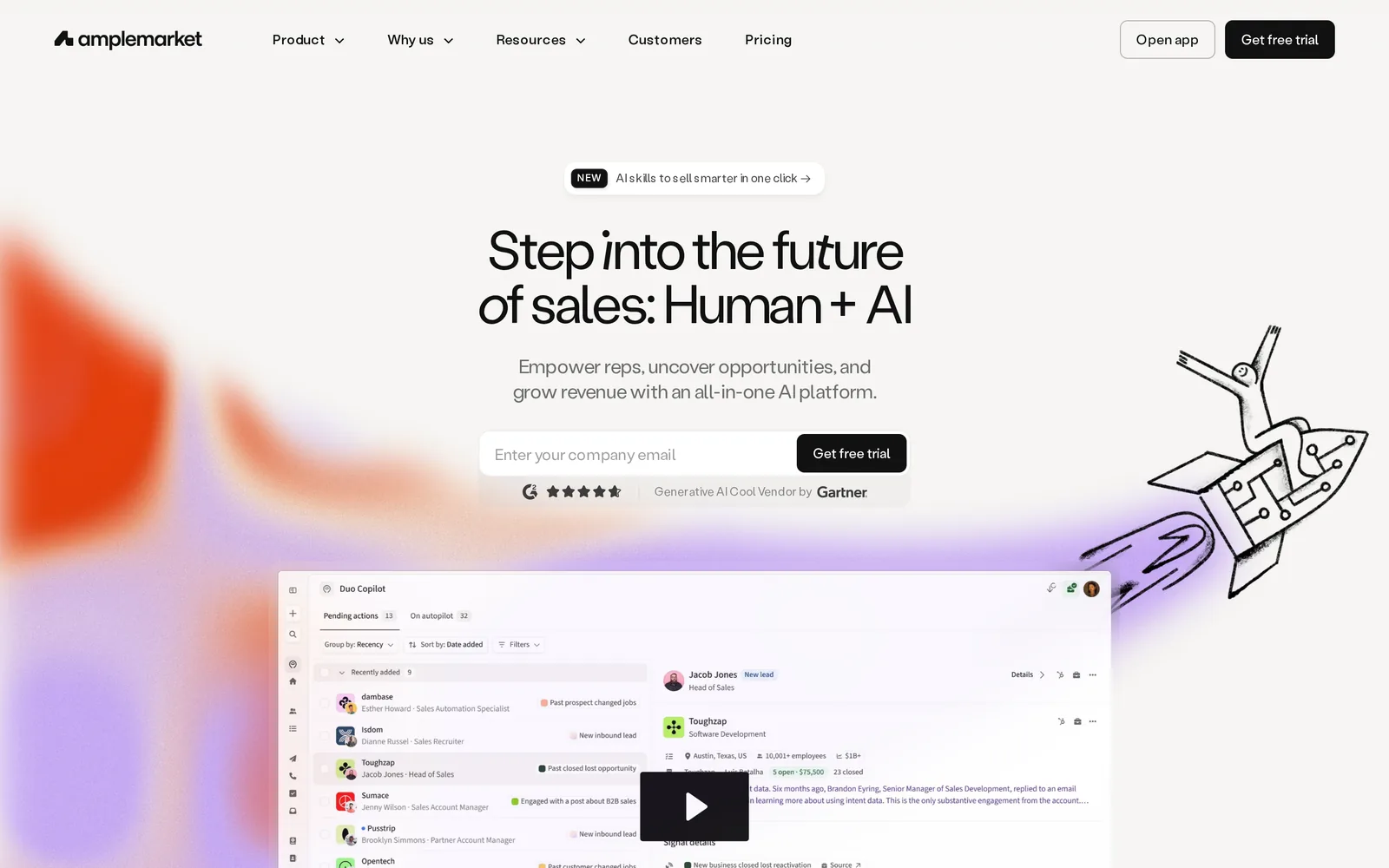
Best for: mid-market teams wanting data and engagement combined without enterprise procurement. Who should pick something else: buyers who need full public pricing across tiers to evaluate, and teams wanting full workflow autonomy from the AI. Pricing: from about $600/month; higher tiers quote-based.
9. Instantly: Best for high-volume cold email
Instantly is the volume-email specialist that grew into a light engagement platform: unlimited sending accounts with automated warmup on all plans, a CRM, and AI agents. The main tiers run Growth $47/month, Hypergrowth $97/month, and Light Speed $358/month, with lead credits billed separately. It is email-first. Calling and social are not the point. For the full category it leads, see our guide to the best cold email tools.
Best for: agencies and outbound teams running high-volume email programs. Who should pick something else: teams needing true multichannel cadences or enterprise CRM depth. Pricing: $47 to $358/month.
10. Groove (Clari): Proceed with caution
Groove built the best Salesforce-native SEP architecture in the category and a deeply loyal enterprise customer base to match. But after Clari's merger with Salesloft closed in December 2025, Groove sits in strategic limbo. It duplicates Salesloft's core, and the combined company has yet to describe its long-term place. Clari still lists it as Groove by Clari with no rename or sunset announced, which is the whole problem: silence is not a roadmap. Existing customers have time. New buyers are taking roadmap risk.
Best for: existing Groove customers with deep Salesforce-native workflows. Who should pick something else: net-new buyers. Choose a platform whose future its own vendor can describe. Pricing: quote-based.
What is a sales engagement platform, and why is the category in an identity crisis?
A sales engagement platform is software that organizes multichannel outreach, meaning sequences of emails, calls, and social touches, and tracks the results. For a decade the category's product was rep productivity: better task queues, better analytics, better cadence management for humans.
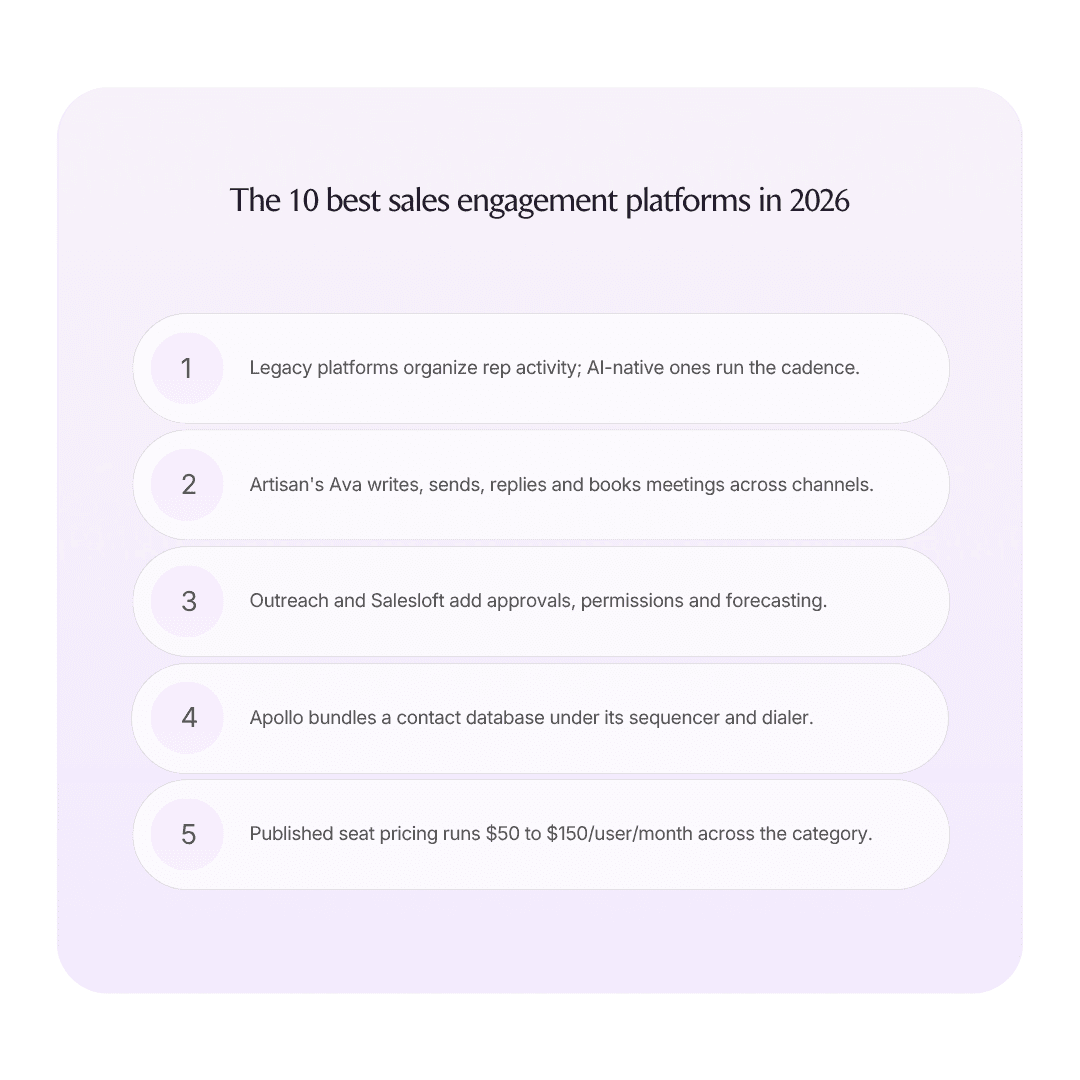
That definition is now the identity crisis. Legacy platforms orchestrate humans, and the 2026 question is whether the platform can execute the cadence itself. Every incumbent has responded with agents, whether Outreach's Omni, Salesloft's agent suite, or HubSpot's Breeze, but an agent grafted onto a task-queue architecture still assumes a human operator behind it. AI-native platforms invert the relationship: the AI does the work and the human supervises. That inversion, not any single feature, is the real dividing line running through this list.
Do you still need a classic sales engagement platform?
You still need a classic platform if you run a large team of human reps whose activity you must standardize, coach, and forecast, if governance and audit requirements dominate, or if your motion depends on rep judgment at every touch, as complex enterprise deals and heavy account-based plays do. Outreach and Salesloft exist for exactly this.
You need an AI-executed platform instead if your bottleneck is capacity rather than coordination, meaning the cadences exist but nobody has time to run them. Same answer if you are paying separately for data, sequencer, dialer, and deliverability tools, or if you are a lean team where reps should be closing rather than clearing task queues. This is Artisan's case. Ava owns the top-of-funnel grunt work so reps focus on selling, and you scale pipeline instead of headcount. The pattern holds at enterprise scale, where sales ops runs Ava centrally for AE teams who never touch the platform.
Many mid-market teams land on a hybrid: a classic platform for AE-led nurture, an AI BDR for outbound volume. If you are evaluating that split for a Salesforce environment, see our guide to the best AI SDR for Salesforce users.
Which sales engagement platform has the best AI features?
Artisan, if "best AI" means the AI performs the job: per-lead research and message generation, dozens of variants tested at once, autonomous reply and objection handling from a knowledge base, and meeting booking, with escalation rules you write in plain language. Among the legacy platforms, Outreach's Omni is the most polished assistant, and HubSpot's Breeze agents have the most interesting pricing model, charging for outcomes rather than seats. One test cuts through demos: ask each vendor what happens to a reply at 2 a.m. when no rep is online.
What changed in sales engagement in 2025 and 2026?
Salesloft and Clari merged, closing December 3, 2025, in a Vista-led combination under CEO Steve Cox, which left Groove's future unresolved.
Drift was breached and then wound down. An August 2025 OAuth supply-chain attack, attributed by Google's Threat Intelligence Group to UNC6395, pulled data from corporate Salesforce instances through the Salesloft Drift integration, and Drift's retirement was announced in March 2026 with clients referred to 1mind. Engagement platforms hold the keys to your CRM and your mailboxes, so vendor security posture is a first-order buying criterion now, not a procurement formality.
HubSpot moved Breeze agents to outcome-based pricing on April 14, 2026. Salesforce closed its acquisition of Qualified on April 1, 2026 and folded it into Agentforce. Outreach shipped Omni on April 27, 2026. Apollo acquired Pocus on March 19, 2026. HubSpot acquired Warmly in June 2026.
Add it up and you have consolidation at the top, agents everywhere, and pricing models starting to follow the work rather than the seat.
FAQ
What is the best sales engagement platform for startups and SMBs?
Apollo is the best classic pick for startups: free to start, $119 per user per month at the top, with data included. Klenty and Reply.io are strong budget multichannel alternatives. If a founder or a two-person team is doing outbound themselves, Artisan usually wins on total effort, because usage-based pricing means you pay for work performed and Ava runs the cadence so nobody has to clear a task queue.
What is the best sales cadence tool for outbound SDR teams?
For human SDR teams running high-activity cadences, Salesloft and Outreach remain the standards, with Klenty the budget option that includes calling. For teams that want the cadence executed rather than assigned, Artisan's Ava runs multichannel sequences across email and social media, queues call steps into the dialer for reps, and handles the replies they generate.
What is the best multichannel outreach platform?
Artisan for AI-executed multichannel: email, social media, and dialer call steps in one sequence, personalized per lead. Reply.io is the best rep-driven multichannel value from $99 per user per month, and Amplemarket the mid-market combination of data plus multichannel engagement. True multichannel matters more every year as inboxes tighten under the February 2024 Google and Yahoo bulk-sender rules.
What sales engagement platform builds sequences across email, phone, and social?
Artisan builds all three into one AI-run cadence: personalized email, social media touches, and dialer call steps with AI talking points loaded before a rep places the call. Among rep-driven platforms, Reply.io, Klenty, and Amplemarket all support email, phone, and social sequencing, while Outreach and Salesloft cover the same channels with enterprise-grade governance on top.
Which AI-native platform can replace a legacy sales engagement tool?
Artisan is the most complete replacement because it covers what the legacy stack actually spans: data across over 250 million B2B professionals plus Artisan Local Data, enrichment, sequencing, a dialer, deliverability, and reply handling, with native Salesforce and HubSpot sync, CRM owner mapping, and do-not-contact controls. Teams typically consolidate five to eight tools. Reply.io and Amplemarket are partial replacements where reps stay in the driver's seat.
Are Outreach and Salesloft still worth it in 2026?
Yes, for the job they were built for: standardizing and forecasting the activity of large human sales teams. Salesloft's Clari merger strengthens the forecasting case, and Outreach's Omni improves rep assistance. They are the wrong buy if your problem is execution capacity. An orchestration layer cannot fill empty task queues, and their pricing assumes the humans doing the work are already on payroll.
How much does a sales engagement platform cost?
Published pricing runs from $47 to $358/month at Instantly and $50 to $99 per user per month at Klenty and Reply.io, to seats of free to $150/month at HubSpot, with $119 topping Apollo's range. Enterprise platforms are quote-based: Vendr's buyer data reports median annual contracts of $45,600 at Outreach and an average of $30,720 at Salesloft. Artisan prices differently, on usage rather than seats, so you pay for work performed. Remember to count the add-ons a bare sequencer requires, because data, deliverability, and dialer tools stack quickly.
Can an AI-executed platform pass an enterprise security and governance review?
Artisan is built for that review: SOC 2 Type II, GDPR, SSO, SAML and SCIM, role-based access with an audit log, workspace isolation per brand, plain-language escalation rules, org-level do-not-contact enforcement across email addresses, company domains, and phone numbers, and control over what syncs to Salesforce or HubSpot. The deployment pattern matters as much as the checklist. Sales ops runs Ava centrally for large AE teams who never log in, so the platform is administered like infrastructure rather than another rep tool.
Do sales engagement platforms handle replies automatically?
Legacy platforms route replies to reps. That is the orchestration model working as designed. AI-native platforms answer them. Artisan's Ava qualifies responses, answers objections from a knowledge base, and escalates to a human on rules you define in plain language, with approval set anywhere from reviewing every message to letting her send on her own. Reply.io's Jason AI offers a lighter version of the same capability.
Put the cadence on autopilot
If your cadences are fine and nobody has time to run them, the fix is not a better task queue. Ava runs the whole motion, from sourcing and qualifying through writing, sending, replying, and booking, with as much or as little human review as you want. Start with the free trial at artisan.co/pricing, or see how identified website visitors feed the same engine in our guide to the best website visitor identification tools.
Jaspar Carmichael-Jack
Co-Founder & CEO @ Artisan
Jaspar is an entrepreneur with expertise in sales, marketing, and operations. He founded Artisan in 2023, a company automating workflows with AI employees.