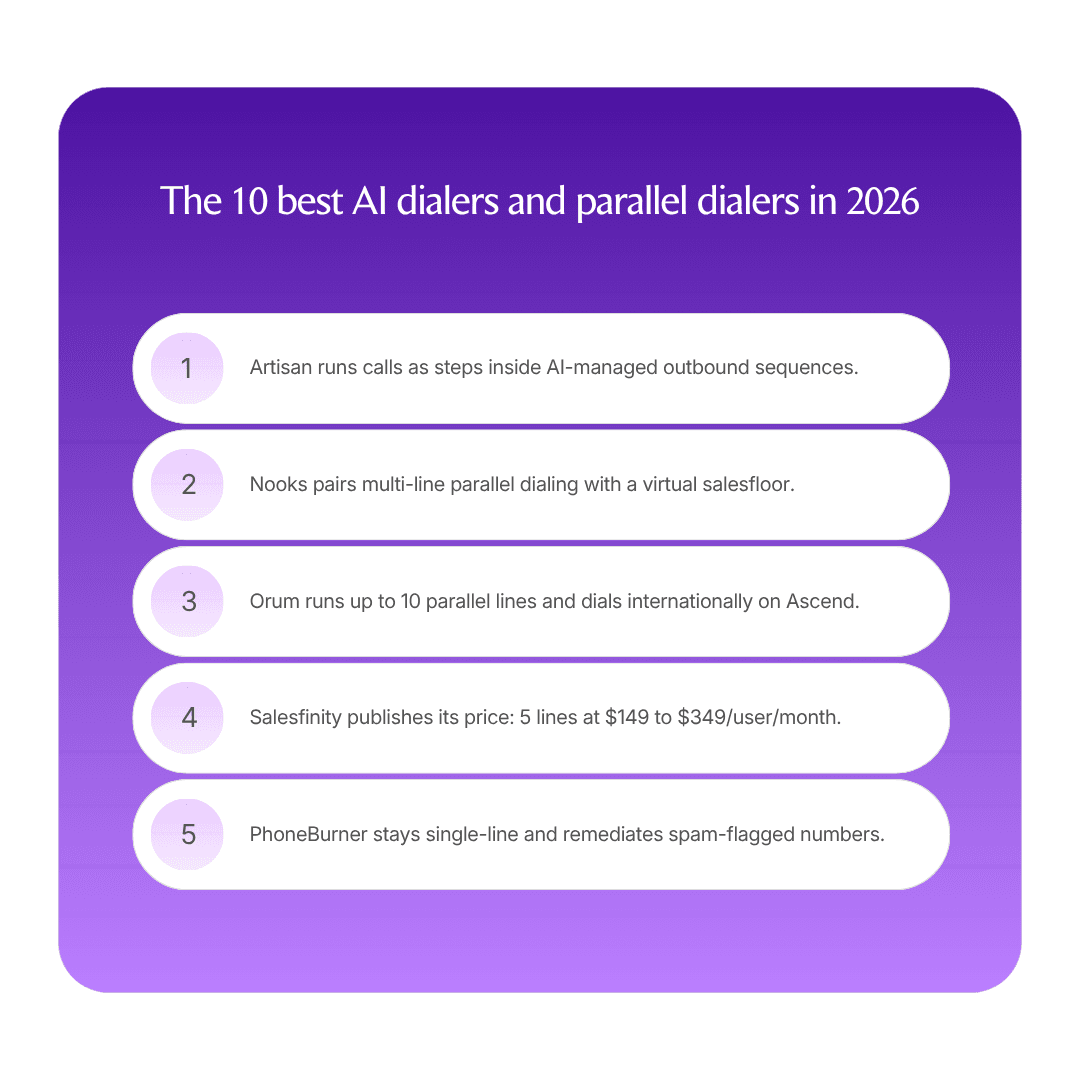
The 10 best AI dialers and parallel dialers in 2026
Ranked guide to AI dialers and parallel dialers in 2026, with public pricing, spam-flag remediation, parallel dialing tradeoffs, and honest fit verdicts.
Key Takeaways
- Dedicated parallel dialers typically cost from $150 to over $300/user/month, sold annually, demo-gated, often with three-seat minimums. Salesfinity ($149 to $349/user/month per its pricing page) is one of the few vendors publishing a per-seat price, and Artisan publishes its usage-based model.
- Nooks and Orum lead the dedicated parallel category: Orum's Ascend runs up to 10 lines with international dialing, and Nooks' $43M Series B funded its growth from dialer into an AI sales assistant platform.
- Spam-likely flagging is the number one buyer objection in this category. Remediation now means number health monitoring, rotation, branded caller ID, and registration with carrier reputation services.
- Parallel dialing multiplies conversations 3x to 10x but introduces dead-air abandonment risk. Predictive dialing is regulated call-center technology with a roughly 3% federal abandonment ceiling.
- Artisan runs calls as steps inside AI-managed multichannel sequences, with power dialing and parallel dialing up to three lines, AI answer detection, waterfall phone enrichment, and spam monitoring built in, all under usage-based pricing.
- At 5 reps, automatic compliance is hygiene; at 100 it is the difference between a program and a lawsuit. Artisan enforces calling hours, do-not-call (DNC) checks, and consent-aware recording per lead, automatically.
- Orum acquired Scout AI in July 2026 to verify and refresh phone numbers with AI agents, a sign the category is converging on data quality, not just dial volume.
The best AI dialer in 2026 depends on what "dialer" means for your team. Artisan is the best choice for teams of any size that want enterprise-grade calling built into one AI-run outbound system instead of bolted on: power dialing and parallel dialing up to 3 lines, with published usage-based pricing that covers the work Ava performs. If your entire motion is maximum-volume parallel calling on up to 10 lines, Nooks and Orum are the category specialists, and this guide says so plainly.
This guide ranks 10 dialers across power, parallel, predictive, and integrated-platform approaches, with public pricing and the spam-flagging realities every buyer should understand before signing an annual contract.
Comparison table
Tool | Best for | Standout capability | Public pricing |
Artisan | Enterprise-grade calling inside one AI-run outbound system, any team size | Call steps in AI sequences with up to 3 parallel lines, AI voicemail drop, and auto-logged outcomes | Usage-based, published (pricing) |
Nooks | SDR teams that live on the phone | Multi-line parallel plus virtual salesfloor and AI coaching | Demo-gated (reportedly ~$4,000 to $5,000/user/year, annual, unverified) |
Orum | Max-volume parallel calling at scale | Up to 10 lines, unlimited dials, international dialing on Ascend | Demo-gated (~$250/user/month reported) |
Salesfinity | Parallel dialing with transparent pricing | 5 lines at published prices | $149 to $349/user/month per its pricing page |
Koncert | Teams that want multiple dialing modes | 4 modes including agent-assisted and AI parallel | Public: $6 to $99/user/month (AI Parallel $99) |
PhoneBurner | Deliberate single-line power dialing | ARMOR spam-reputation remediation, branded caller ID | $140 to $183/user/month annual, per its pricing page |
Kixie | CRM-embedded SMB calling | Multi-Line PowerDialer plan (reportedly up to ~10 lines); ConnectionBoost is a separate connect-rate add-on | Quote-gated (historically $35 to $95/user/month) |
JustCall | Budget phone platform with predictive option | Predictive dialing up to 10 lines on SalesPro | $29 to $89/user/month annual, per its pricing page |
CloudTalk | International calling flexibility | Parallel add-on (10 lines) on a call-center platform | €19 to €49/user/month plus €39 parallel add-on, per its pricing page |
Trellus | Adding AI dialing to an existing sequencer | Browser overlay on Salesloft, Outreach, Apollo, HubSpot | Free tier, then $59.99 to $149.99/month, per its pricing page |
How we chose
We evaluated each tool on five criteria: connect-rate mechanics (lines, answer detection, local presence), spam-reputation protection, conversation intelligence (transcription, coaching, outcome logging), CRM depth (Salesforce and HubSpot logging), and total cost including add-ons. Pricing is attributed to vendor pricing pages, and gated pricing is marked as reported and unverified.
What are the best AI dialers and parallel dialers in 2026?
1. Artisan: Best enterprise-grade dialer inside one AI-run outbound system
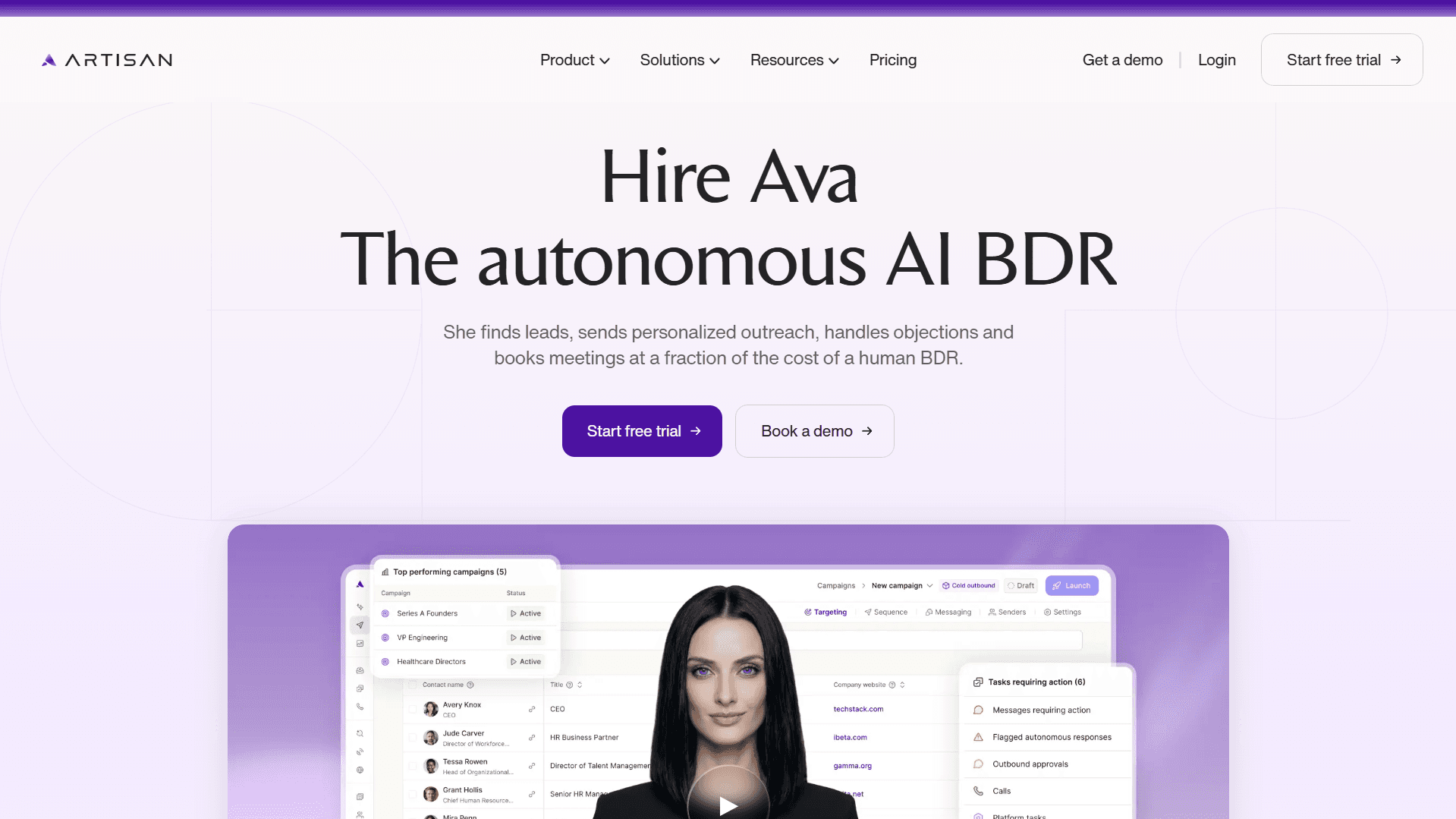
Artisan is an AI-first outbound platform whose AI business development representative (BDR), Ava, runs the full motion: sourcing from a database of over 250 million B2B professionals across over 200 countries, enrichment, personalized email and social media outreach, reply handling, and booking. The dialer is not a separate product. Calls run as steps inside multichannel sequences, so a call step is queued automatically when a prospect opens a second email, with AI talking points loaded before the call connects, live transcription, auto-classified outcomes, and an AI-drafted follow-up email waiting when you hang up.
The parts most dialers charge extra for are built in: waterfall phone enrichment across roughly a dozen providers (you are only charged when a number is found), automatic number ramp-up, AI voicemail drop, automatic area-code matching so prospects see a true local number, spam monitoring via carrier reputation services, lead-local calling-hours enforcement, and federal DNC checks. Recordings and transcripts sync natively to Salesforce and HubSpot record timelines. Numbers are available in the US, Canada, UK, Mexico, and Colombia, pooled at the org level, with personal callback routing, so a lead who calls back the org number reaches the right rep's phone.
Central administration is where large teams feel the difference: CRM owner mapping logs every call to the right rep's record, per-number call ceilings protect reputation, and carrier spam monitoring covers a whole team's numbers, because one flagged number drags down everyone's connect rates. Compliance (calling hours, DNC, consent-aware recording) runs automatically per lead. At 5 reps that is hygiene. At 100 reps it is the difference between a program and a lawsuit.
Parallel dialing is built in as well: up to 3 lines with AI answer detection, engineered behind those compliance guardrails (plus abandonment-safe pacing) instead of ahead of them. The honest caveat is narrow. Nooks and Orum go to 5 to 10 simultaneous lines, so a team whose entire motion is maximum-volume parallel cold calling may still want one. Artisan wins for teams of any size that want calling coordinated with the rest of outbound. Bruno Didier, CEO of CookUnity Business, puts the platform effect this way: "Ava runs highly targeted outreach at a scale we could never reach with a human-only team." CookUnity's cost per lead runs roughly $45 across over 100,000 personalized emails.
Pricing is published and usage-based. You pay for the work Ava performs across qualifying, enriching, personalizing, and sending, and the dialer's live AI talking points, transcription, AI-drafted follow-ups, recordings, and analytics run inside that same platform instead of a separate per-seat license. Dedicated parallel dialers run from $200 to over $300/user/month. Artisan has a free trial and no platform fee (details at artisan.co/pricing).
Who should pick something else: dedicated call-blitz teams that need 5 to 10 simultaneous lines, and teams that want a standalone phone system with no sequencing attached.
2. Nooks: Best parallel dialer for SDR teams
Nooks grew from a virtual salesfloor into an AI sales assistant platform: multi-line parallel calling with AI answer detection, voicemail drop, live transcription, AI training bots for rep practice, an AI Prospector, and over 100 buying signals. The salesfloor DNA still shows. Reps dial together, managers listen in and coach live, and the energy of a physical call floor survives remote work. It raised a $43M Series B led by Kleiner Perkins in October 2024. For more, see our Nooks pricing and reviews breakdown and how Artisan vs. Nooks compare.
Best for: teams of sales development representatives (SDRs) that make calling their primary channel and want coaching culture built into the tool.
Who should pick something else: budget-conscious teams, since pricing is demo-only (third-party trackers report roughly $4,000 to $5,000/user/year, annual, unverified), and teams that mostly need email and social media sequencing.
3. Orum: Best parallel dialer for max-volume call floors
Orum is the max-volume pick: Launch runs 5 parallel lines, Ascend runs 10 with international dialing, both with unlimited dials and a 3-seat minimum. Boost Connect manages number reputation, and in July 2026 Orum acquired Scout AI, whose agents verify and refresh phone numbers before reps dial. This attacks bad data, the silent killer of connect rates. Reported pricing is around $250/user/month, gated behind a demo. See how Artisan vs. Orum compare.
Best for: SDR orgs whose whole motion is maximum-volume calling and who need international coverage and procurement-grade vendor maturity.
Who should pick something else: teams under three seats, and anyone who wants published pricing.
4. Salesfinity: Best transparent pricing in parallel dialing
Salesfinity does something rare in this category: it publishes prices. Starter at $149 and Professional at $349/user/month buy five parallel lines, per its pricing page, with the usual AI answer detection and CRM logging.
Best for: mid-market teams that want parallel dialing without a procurement dance.
Who should pick something else: enterprises that need 10 lines and broad international coverage (Orum), or teams that want a longer vendor track record before buying.
5. Koncert: Best for multiple dialing modes
Koncert ships 4 dialing modes, including agent-assisted dialing (human agents dial and navigate phone trees before transferring a live prospect to your rep) and Symphony AI parallel dialing (reportedly up to 5 lines, marketed up to 10). Its Caller ID Heat Map monitors number health and DNC scrubbing is built in. Pricing is public: a ladder from Click at $6 to AI Parallel (Symphony) at $99/user/month.
Best for: teams that want to match dialing mode to list quality, using agent-assisted for high-value accounts and parallel for volume.
Who should pick something else: teams that want one simple mode and modern UX. Some reviewers describe the interface as dated.
6. PhoneBurner: Best single-line power dialer
PhoneBurner takes an explicit anti-parallel stance: one call at a time, no abandonment delay, no dead air greeting your prospect. Its ARMOR spam-reputation remediation and branded caller ID directly attack the category's biggest problem, and pricing is published at $140, $165, or $183/user/month billed annually, per its pricing page.
Best for: teams that value answer experience and number reputation over raw dial volume, often those calling warmer or smaller lists.
Who should pick something else: high-volume cold-call teams for whom 3x to 10x conversation multiplication outweighs the abandonment tradeoff.
7. Kixie: Best CRM-embedded dialer for SMBs
Kixie's PowerCall lives inside your CRM, with a separate Multi-Line PowerDialer plan (reportedly up to around 10 lines) and ConnectionBoost, a connect-rate add-on providing local presence numbers and spam remediation. It is a favorite of small and medium-sized businesses (SMBs) that run HubSpot or Pipedrive and want calling, texting, and logging in one place. Pricing is quote-gated (historically $35 to $95/user/month). For a head-to-head, see Kixie vs. JustCall.
Best for: SMB and lower mid-market teams that want the dialer where their CRM lives.
Who should pick something else: enterprise teams that need 10-line volume or formal compliance tooling.
8. JustCall: Best budget option with a predictive mode
JustCall is a full phone platform at $29, $49, or $89/user/month billed annually, per its pricing page, with the SalesPro tier adding predictive dialing across up to 10 lines and an AI voice agent priced at $0.99/minute. It is a phone system first, a sales dialer second.
Best for: startups and SMBs that need calling, SMS, and WhatsApp on a budget with room to grow into multi-line dialing.
Who should pick something else: dedicated SDR floors that will outgrow a generalist phone platform's coaching and salesfloor features.
9. CloudTalk: Best for international call-center flexibility
CloudTalk is a European call-center platform (€19 to €49/user/month, per its pricing page) with a Parallel add-on at €39/user/month that opens up 10 lines, plus AI voice agents from €0.15/minute. It suits teams that blend outbound sales with support calling across many countries.
Best for: international teams that need local numbers in many markets and mixed sales-plus-support calling.
Who should pick something else: US-centric SDR teams, which will find purpose-built parallel dialers sharper on coaching and connect mechanics.
10. Trellus: Best budget AI overlay on your existing sequencer
Trellus is a browser extension that adds AI dialing and real-time coaching on top of Salesloft, Outreach, Apollo, or HubSpot, with up to five lines on paid tiers ($59.99 to $149.99/month, per its pricing page) and a free tier to start.
Best for: individual reps and small teams that already pay for a sequencer and want multi-line dialing without a second platform contract.
Who should pick something else: teams that want a standalone system of record for calls. An overlay inherits the limits of whatever it sits on.
What is the difference between a power dialer, a parallel dialer, and a predictive dialer?
A power dialer calls one number at a time and auto-advances through your list when a call ends. No abandonment risk, no dead air, roughly 60 to 80 dials per rep-hour. A parallel dialer calls 3 to 10 numbers simultaneously per rep, uses AI answer detection to spot a human, and connects the first live answer, which multiplies conversations 3x to 10x at the cost of occasional dead-air moments when a second prospect answers at the same moment (the second hears silence or is dropped). A predictive dialer is call-center technology: an algorithm over-dials across a whole agent team based on statistical answer rates, and US regulators cap abandoned calls at roughly 3% of live answers. Most B2B SDR teams in 2026 choose between power (PhoneBurner, Kixie) and parallel (Nooks, Orum, Salesfinity, or Artisan's 3-line call steps inside sequences). Predictive suits high-volume teams of over 10 agents working consumer-grade lists (JustCall SalesPro, Close). For broader roundups, see the best autodialers and the best outbound dialer.
Which dialer reduces spam-likely flagging on outbound calls?
Spam flagging is the category's number one objection, and every serious vendor now sells remediation. When carriers' analytics engines see a number making hundreds of short-duration outbound calls, they label it "Spam Likely," and answer rates collapse. The 2026 toolkit is straightforward: register numbers with carrier reputation services and the Free Caller Registry, buy branded caller ID (CNAM) so your company name displays, rotate numbers and monitor their health, and introduce new numbers gradually instead of blasting from day one. PhoneBurner's ARMOR and single-line stance, Orum's Boost Connect, Koncert's Caller ID Heat Map, and Kixie's ConnectionBoost are all remediation products. Artisan builds this into the sequence layer (automatic number ramp-up, per-number call ceilings, spam monitoring via carrier reputation services, automatic area-code matching, and lead-local calling-hours enforcement) so reputation management is not an add-on you remember to buy. Pooled org-level numbers monitored centrally mean one rep's volume cannot quietly erode a whole team's connect rates. No vendor can guarantee zero flags. Be skeptical of any that claims to.
How much do parallel dialers cost in 2026?
Expect from $150 to over $300/user/month for dedicated parallel dialers, sold annually, usually demo-gated, often with three-seat minimums, so a five-rep team should budget roughly $12,000 to $18,000 per year before phone-number and data costs. Published anchors include Salesfinity at $149 to $349/user/month (per its pricing page) and PhoneBurner's single-line power dialer at $140 to $183 (per its pricing page). Reported but unverified figures include Nooks at roughly $4,000 to $5,000/user/year (annual, demo-gated) and Orum around $250/user/month, per third-party trackers. Artisan takes a different shape. Its pricing is usage-based and published, so calling sits inside the work Ava already performs instead of a separate per-seat license, and you can budget it without ever taking a sales call. Cheaper paths exist too, like CloudTalk's €39 parallel add-on, JustCall's $89 SalesPro tier, or Trellus from $59.99/month on top of a sequencer you already own. Phone enrichment is charged only on success (pricing).
What is the best dialer that integrates with Salesforce and HubSpot?
Most tools here log calls to Salesforce and HubSpot. The difference is depth. Kixie is the strongest pure CRM-embedded experience for SMBs, since the dialer lives in the CRM. Orum and Nooks both sync dispositions and recordings for enterprise Salesforce orgs. Artisan goes further than call logging: emails, calls, and meetings all log natively on the CRM record timeline, campaigns can source from dynamic CRM lists, owner mapping keeps outreach coming from the right rep, and deal-based do-not-contact blocks calls to any account with an open opportunity. The dialer inherits the whole platform's CRM logic. Teams evaluating enterprise-grade Salesforce fit should also see our guide to the best AI SDR for Salesforce users.
What changed in the dialer category in 2025 and 2026?
Orum acquired Scout AI (announced July 15, 2026), adding AI agents that verify and refresh phone numbers, a signal the category's frontier is data quality rather than more lines.
Nooks' $43M Series B (Kleiner Perkins, October 2024) funded its expansion from dialer to AI sales assistant platform with training bots and an AI Prospector.
Per-minute AI voice agents went mainstream: JustCall at $0.99/minute and CloudTalk from €0.15/minute now sit alongside human dialing on the same platforms.
Spam remediation became a product line, not a feature. PhoneBurner's ARMOR and branded caller ID offerings across vendors responded to carrier analytics tightening through 2025 and 2026.
Sequencers absorbed dialers: Klenty added a 5-to-10-line AI dialer, Apollo sells a dialer add-on, and Artisan runs calls, including 3-line parallel dialing, as sequence steps, squeezing standalone dialers from both sides.
Frequently asked questions
What is the best AI dialer for B2B sales teams?
Artisan, if you want calling as one channel inside an AI-run outbound system with parallel dialing up to 3 lines, enrichment, spam monitoring, and CRM-native logging built in, all under published usage-based pricing. Nooks is the best dedicated parallel dialer for SDR-floor teams, and Orum is the strongest max-volume option with up to 10 lines and international dialing. The right answer depends on whether calling is your whole motion or one step in it.
What is the best parallel dialer for startups and SMBs?
Artisan is the most accessible parallel-capable option for a small team, because calling runs inside usage-based pricing instead of a separate per-seat license, on the same model whether you have 2 reps or 200. Salesfinity offers transparent dedicated-dialer pricing at $149 to $349/user/month (per its pricing page) with 5 parallel lines and no demo-gated procurement cycle, and Trellus is the overlay path, from $59.99/month on Apollo or HubSpot with a free tier to test.
Which dialer connects reps to the most live conversations?
Parallel dialers maximize raw conversations: Orum's Ascend (10 lines) and Nooks (multi-line, with AI answer detection) typically multiply conversations 3x to 10x versus manual dialing. But connect volume also depends on number reputation and data quality. A flagged number or dead list zeroes out any line count, which is why Orum bought Scout AI and why Artisan runs waterfall phone enrichment across roughly a dozen providers before a call is ever placed.
Which dialer has automatic voicemail drop?
Voicemail drop, leaving a pre-recorded message with one click and moving on, is standard across the category: Nooks, Orum, Salesfinity, Koncert, PhoneBurner, Kixie, and JustCall all include it, and Artisan ships AI voicemail drop inside its sequence call steps. It saves roughly 30 to 60 seconds per unanswered call, which compounds across hundreds of daily dials.
Which AI dialer transcribes and coaches calls automatically?
Nooks and Trellus lead on real-time coaching. Trellus shows live prompts during the call, and Nooks adds AI training bots for practice sessions plus salesfloor listen-ins. Artisan transcribes calls live, auto-classifies outcomes, and drafts the follow-up email from the transcript, syncing everything to Salesforce or HubSpot. Teams with dedicated conversation-intelligence budgets often pair a dialer with a platform like Gong, but built-in transcription now covers most SDR needs. New reps can start from proven cold calling scripts.
What dialer offers local presence dialing?
Kixie's ConnectionBoost is the best-known local presence feature, showing prospects a number matching their area code, and most parallel dialers (Nooks, Orum, Salesfinity, Koncert) offer local numbers with rotation. Artisan matches area codes automatically, so prospects see a true local number without a rep configuring anything. Use local presence carefully. Carriers' analytics increasingly penalize aggressive local-presence rotation, so pair it with number health monitoring and branded caller ID.
What is the best predictive dialer?
For true predictive dialing (algorithmic over-dialing across an agent team), JustCall SalesPro (up to 10 lines, from $89/user/month per its pricing page) and Close ($139/user/month) are the accessible options, while classic call-center suites serve larger floors. The constraint matters: US rules cap abandoned calls at roughly 3%, and predictive economics only work with over 10 agents dialing simultaneously. Most B2B SDR teams want parallel, not predictive.
Is parallel dialing legal and compliant?
Parallel dialing is legal for B2B cold calling in the US when done properly, but it lives near real regulatory lines: DNC-list compliance, state calling-hours rules, and abandonment standards written for predictive dialers. This is why Artisan built its three-line parallel dialing behind compliance guardrails: abandonment-safe pacing, federal DNC checks, consent-aware recording, and lead-local calling-hours enforcement, all on by default. Ask any parallel vendor how they handle DNC scrubbing and abandoned-call behavior before you buy.
Which AI dialer is best for a large sales team?
The deciding factor is motion, not headcount. If the whole floor's job is maximum-volume parallel calling, Orum (up to 10 lines, international dialing) and Nooks are the specialists. If calling is one coordinated channel in a bigger outbound motion, Artisan runs centrally at scale: pooled org-level numbers with personal callback routing, CRM owner mapping, per-number call ceilings, team-wide spam monitoring, and per-lead compliance enforced automatically, all under usage-based pricing that follows the work performed instead of a per-seat license that climbs with headcount.
Do I still need a separate dialer if I use an AI SDR platform?
Increasingly, no, unless calling is your dominant channel. Platforms like Artisan include the dialer inside sequenced outreach, with enrichment, talking points, transcription, and CRM logging attached. See our guides to outbound sales software and the best cold email tools for how the channels fit together. Dedicated call floors that run thousands of daily dials still justify a specialist parallel dialer alongside.
Put calling inside a system that runs itself
A dialer makes reps faster at one task. Artisan makes the whole outbound motion (sourcing, enrichment, email, social media, calls, replies, booking) run as one system, with Ava, the AI BDR, doing as much of the work as you choose to hand her. Calls arrive pre-researched, with talking points loaded and the follow-up email drafted before you put the phone down. Start a free trial at artisan.co or see how usage-based pricing works.
Related reading

Artisan Team
Expert insights from the team at Artisan
Our writing team blends direct operational experience, in-house data, and thorough research to bring you the very latest insights and updates about sales and GTM automation.